


The US Dollar Index (DXY) has declined by more than 10% year-to-date, losing a large portion of its post-pandemic rally. This move has brought the dollar back toward a long-term support zone that has held for nearly 15 years, placing the US dollar outlook for 2026 firmly in focus for global markets.
The focus now is whether the US dollar holds this long-term support and stabilizes, or breaks below it and extends its weakness into 2026.
US Dollar Outlook for 2026: What the DXY Chart Is Signaling
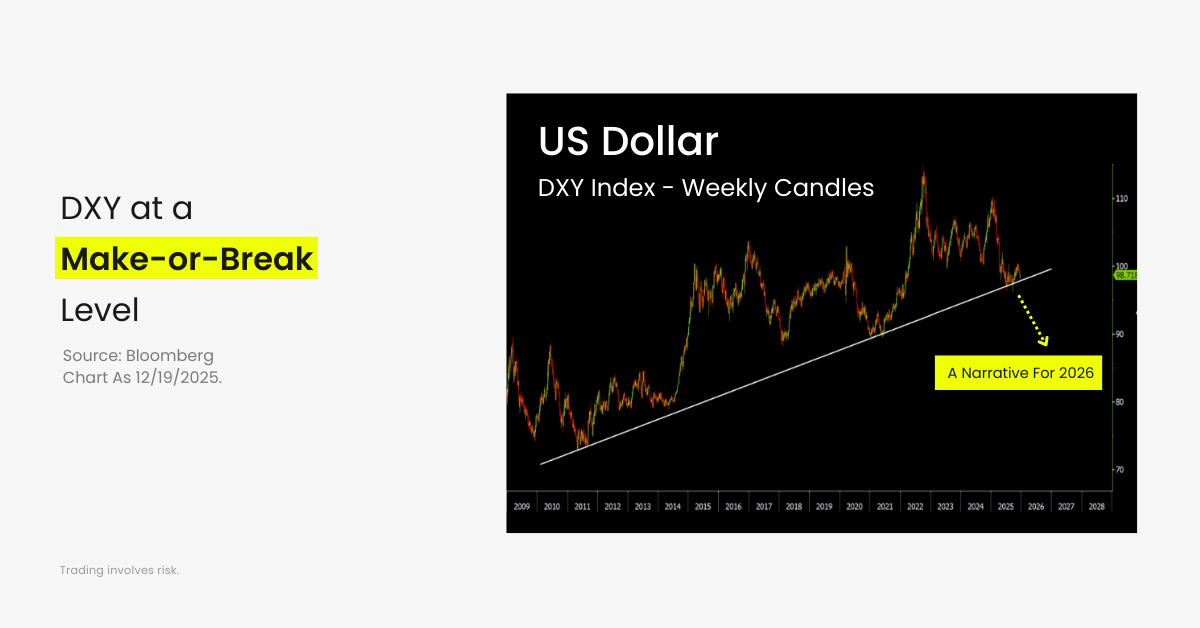
The DXY has returned to an area that has historically attracted buyers during past pullbacks. However, that support has now been tested multiple times, especially in recent months. In market terms, repeated tests of long-term levels often draw close attention, as they can signal growing pressure if underlying conditions fail to improve.
A break below this trend line could signal a growing downside risk for the USD in 2026.
Rather than pointing to a certain outcome, the chart reflects a moment of structural importance, where policy direction, capital flows, and macro conditions are likely to matter more than short-term sentiment.
Rate Cuts and the Policy Shift in 2026
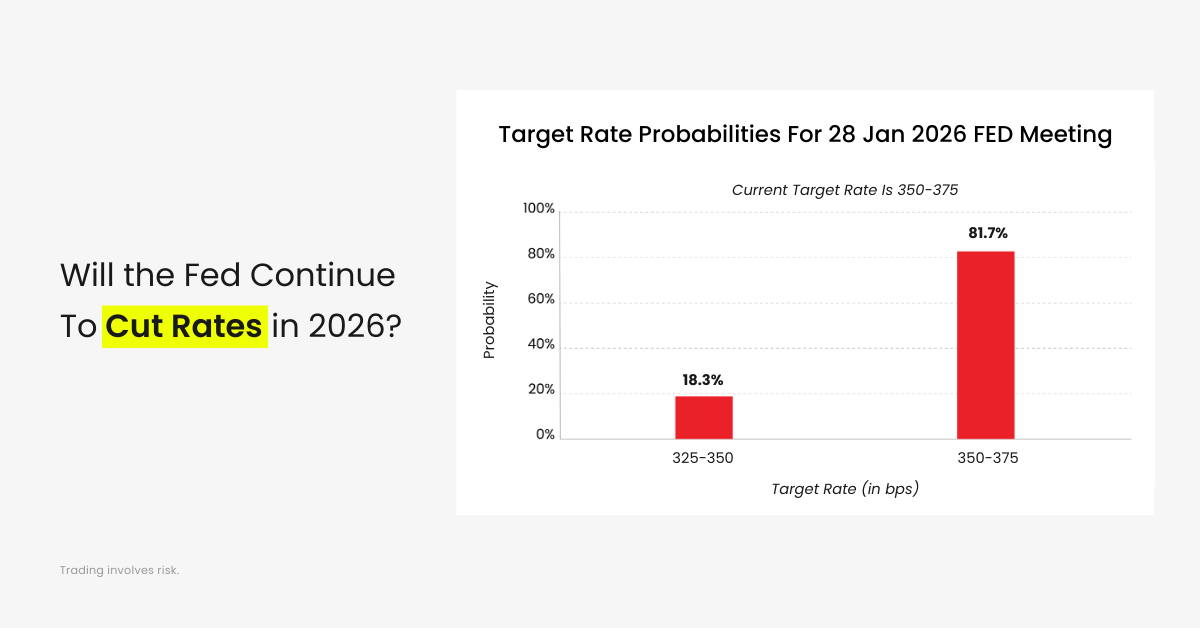
One of the clearest headwinds shaping the US dollar outlook for 2026 is the interest rate cycle.
Markets are increasingly pricing in further Federal Reserve rate cuts, especially if inflation continues to cool and labor market data shows signs of softening. Lower interest rates tend to reduce the yield advantage that has supported the dollar in recent years.
Even before cuts occur, expectations alone can weigh on a currency. In 2025, the dollar responded less to absolute data levels and more to how each release reshaped views on future Fed policy. That dynamic is likely to remain in place as 2026 approaches.
De-Dollarization and Global Reserve Shifts
Another longer-term factor influencing the dollar is the ongoing de-dollarization trend.
Several countries have continued to diversify reserves away from US Treasuries and toward alternative assets, including gold. While this process is gradual and uneven, it reflects a broader effort to reduce reliance on the US-centric financial system.
At the same time, central bank gold purchases have remained elevated, reinforcing the idea that some institutions are seeking stores of value outside traditional fiat currencies. This shift does not signal the end of the dollar’s reserve status, but it does suggest that global demand dynamics are evolving.
Precious Metals and the US Dollar Outlook
Gold and silver have surged to new all-time highs, and their strength has moved largely in the opposite direction of the dollar.
Historically, periods of dollar weakness, falling real yields, and rising geopolitical uncertainty have tended to support precious metals. In 2025, that relationship re-emerged as inflation eased, rate expectations shifted, and global tensions remained elevated.
If these conditions persist, the dollar may continue to face competition from hard assets as a preferred store of value.
Geopolitics and Fiscal Pressures
Geopolitical risks also remain part of the equation.
Ongoing conflicts, trade fragmentation, and fiscal pressures have increased uncertainty across global markets. For the US, rising debt levels and higher interest costs add another layer of complexity, particularly if growth slows while financing needs remain elevated.
Historically, environments marked by large fiscal deficits have often coincided with policies aimed at easing financial conditions over time, which can be challenging to sustain alongside a strong currency.
The Major Outlier: A Recession Scenario in 2026
Despite the growing list of factors weighing on the US Dollar outlook for 2026, one important outlier remains.
If a global or US-led recession were to materialize, the dollar could still strengthen. In past downturns, the USD has often benefited from its role as the world’s primary reserve and funding currency, attracting demand during periods of risk aversion.
In such a scenario, risk assets could come under pressure while the dollar temporarily regains strength, even if the longer-term structural picture remains complex.
So, Will the Bearish Trend Continue in 2026?
As things stand, the balance of factors influencing the US dollar outlook for 2026 points toward continued pressure, particularly if rate cuts advance, de-dollarization trends persist, and precious metals remain in demand.
However, the dollar’s position near long-term support highlights that 2026 may be less about straight-line moves and more about how macro conditions evolve. Policy decisions, growth outcomes, and global risk dynamics will ultimately determine whether the recent bearish trend extends or stabilizes.
For now, the dollar sits at a crossroads, with 2026 shaping up to be a defining year for its next chapter.
Risk Disclosure
Trading in Securities, Futures, contracts for difference (CFDs) and other financial products carries high risks due to the rapid and unpredictable fluctuation in the value and prices of these financial instruments. This unpredictability is due to the adverse and unpredictable market movements, geopolitical events, economic data releases, and other unforeseen circumstances. You may sustain substantial losses including losses exceeding your initial investment within a short period of time.
You are strongly advised to fully understand the nature and inherent risks of trading with the respective financial instrument before engaging in any transactions with us. When you engage in transactions with us, you acknowledge that you are aware of and accept these risks. You should conduct your own research and consult with an independent qualified financial advisor or professional before making any financial, trading or investment decisions. This blog may contain speculative statements regarding future expectations, plans, or projections based on information and assumptions currently available to D Prime. Although D Prime considers these assumptions reasonable, such statements involve risks, uncertainties, and factors beyond D Prime’s control, and actual outcomes may differ significantly.
Disclaimer
This information contained in this blog is for general informational purposes only and should not be considered as financial, investment, legal, tax or any other form of professional advice, recommendation, an offer, or an invitation to buy or sell any financial instruments. The content herein, including but not limited to data, analyses and market commentary, is presented based on internal records and/or publicly available information and may be subject to change or revision at anytime without notice and it does not consider any specific recipient’s investment objectives or financial situation. Past performance references are not reliable indicators of future performance.
D Prime and its affiliates make no representations or warranties about the accuracy or completeness or reliability of this information and disclaim any and all liability for any direct, indirect, incidental, consequential, or other losses or damages arising out of or in connection with the use of or reliance on any information contained in this blog. The above information should not be used or considered as the basis for any trading decisions or as an invitation to engage in any transaction. Do not rely on this report to replace your independent judgment. You should conduct your own research and consult with an independent qualified financial advisor or professional before making any financial trading or investment decisions.