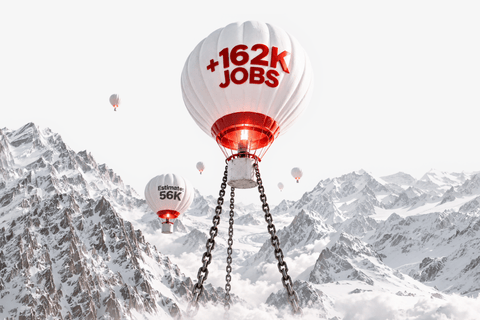


US July CPI cooled as Fed rate-hike bets faded, putting gold and tech stocks in focus as markets reassess real yields and liquidity.
US July CPI gave markets another reason to question the Fed rate-hike narrative.
Released on August 12, US July CPI fell from 3.5% to 3.4% year over year, while core CPI eased from 2.6% to 2.5%. Both readings were broadly in line with expectations.
At first glance, the decline looks small.
But in this market, even a few tenths of a percentage point matter.
Inflation is cooling just as growth and employment are losing momentum. June PCE fell 0.1% month over month, marking the first negative monthly reading since the 2020 COVID outbreak. Q2 GDP grew at only a 1.5% seasonally adjusted annual rate, below the market consensus of 2.1%. July nonfarm payrolls also unexpectedly turned negative.
Together, the message is clear: the US economy is slowing, inflation pressure is easing, and the case for a Q3 Fed rate hike is getting weaker.
This matches D Prime’s long-held view. The probability of a Q3 rate hike remains low, while Q4 still depends on incoming data.
But for markets, this is not necessarily bad news.
If rate-hike expectations fade, liquidity may not tighten further. That raises two major questions for traders: can tech stocks rebound, and is gold finally entering a stronger bullish setup?
Why July CPI Weakens the Fed Rate-Hike Case
July CPI came in at 3.4% year over year, while core CPI reached 2.5%. Both numbers matched expectations and showed inflation continuing to move lower.
The broader data points in the same direction.
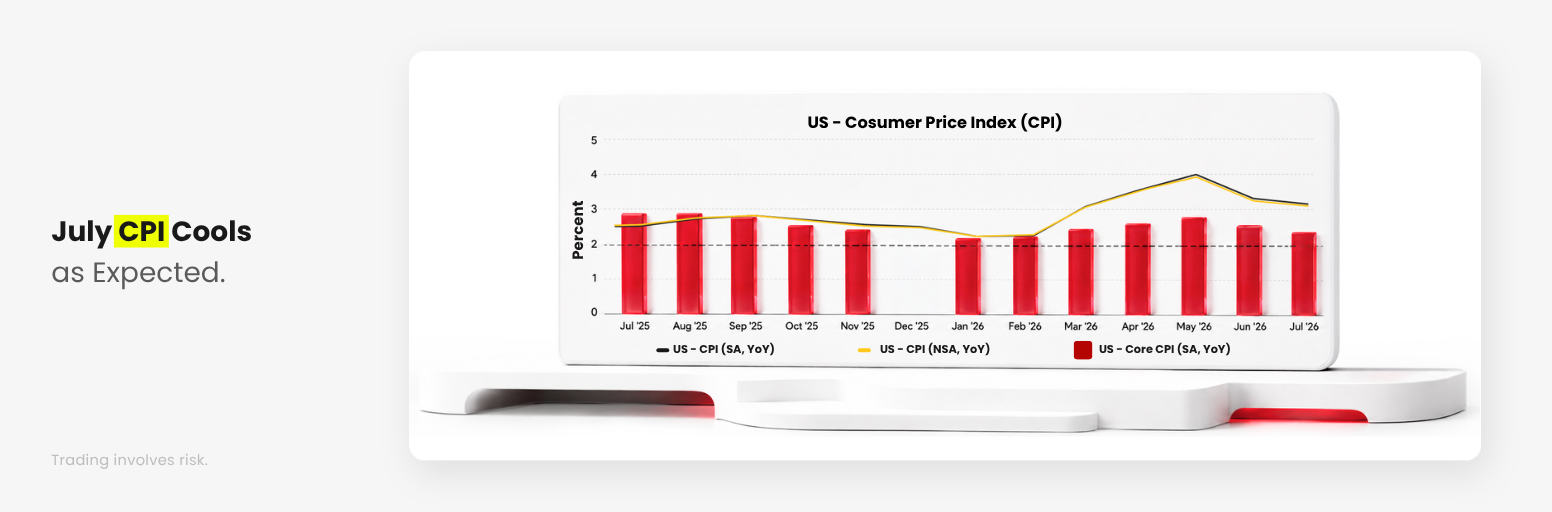
June PCE stood at 3.7% year over year and fell 0.1% month over month, while core PCE came in at 3.3% year over year. The month-over-month decline was the first negative reading since the 2020 COVID pandemic.
This matters because inflation is no longer the only data point weakening.
D Prime has already discussed the broader slowdown in previous articles, including “US Q2 GDP Growth Slows, But Recession Fears Look Overdone” and “July Nonfarm Payrolls Miss: Why the Fed May Stay on Hold.”
The latest data gives markets three clear signals: GDP growth is slowing, nonfarm payrolls have weakened, and CPI is cooling.
That combination makes it difficult for the Fed to justify an immediate rate hike.
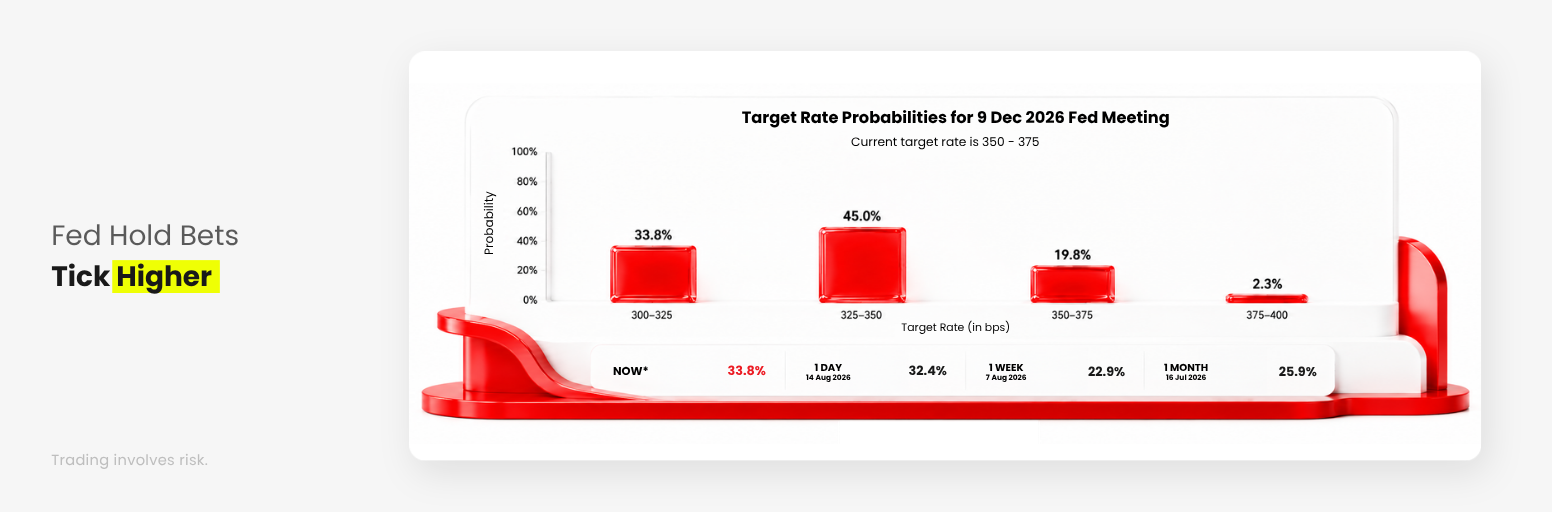
As of now, the market sees a 33.8% probability that rates will remain unchanged in September, up from only 22.9% a week earlier.
In other words, rate-hike expectations have taken another hit.
Why a Preemptive Fed Hike Looks Unlikely
Some hawkish voices still argue that the Fed may need to act early.
Their argument often points to the so-called preemptive rate hike used by Alan Greenspan in 1997, when the Fed raised rates ahead of time to control inflation before it became harder to manage.
But today’s situation is different.
A preemptive hike is usually used when the economy is overheating, inflation pressure is broadening, and labor demand remains strong.
That is not what the current data shows.
Inflation is still above target, but GDP growth is slowing, employment is weakening, and inflation pressure does not appear broad enough to justify a forceful preemptive move.
D Prime believes the Fed is more likely to stay cautious in Q3. The central bank does not need to rush into another hike when growth is already cooling and the labor market is showing signs of weakness.
That does not mean rate-hike risk has disappeared completely. Q4 still needs to be watched, especially if oil prices rise again or inflation unexpectedly rebounds.
But for Q3, the bar for another hike looks higher than before.
How Much Does AI Really Add to Inflation?
There is another inflation debate markets cannot ignore: AI inflation.
As AI development accelerates, prices for semiconductor components, memory chips, and related hardware have risen sharply. Stocks such as Micron and SanDisk have repeatedly reached new highs, supported by strong demand from AI infrastructure.
So can AI push inflation higher?
D Prime believes the direct impact is limited.
AI-related inflation mainly comes from two areas. The first is electricity, driven by rising power demand from data centers. The second is consumer electronics, where higher chip and memory prices may eventually pass through to end users.
Over the past three months, CPI averaged around 3.7% year over year. AI-related components contributed only about 0.07 percentage points to that number.
For PCE, the contribution was slightly larger at around 0.21 percentage points, with electricity accounting for the largest share.
The difference between CPI and PCE mainly comes from different weightings. Computer software and accessories have only a 0.03% weighting in CPI, but the weighting is much higher in PCE at 1.15%.
PCE includes consumption that users benefit from even when they do not pay for it directly. Free large language models are one example. Enterprises may absorb the cost of providing these tools, while users enjoy the service without paying out of pocket. That activity can still contribute to PCE.
This means AI may have a bigger visible effect in PCE than in CPI.
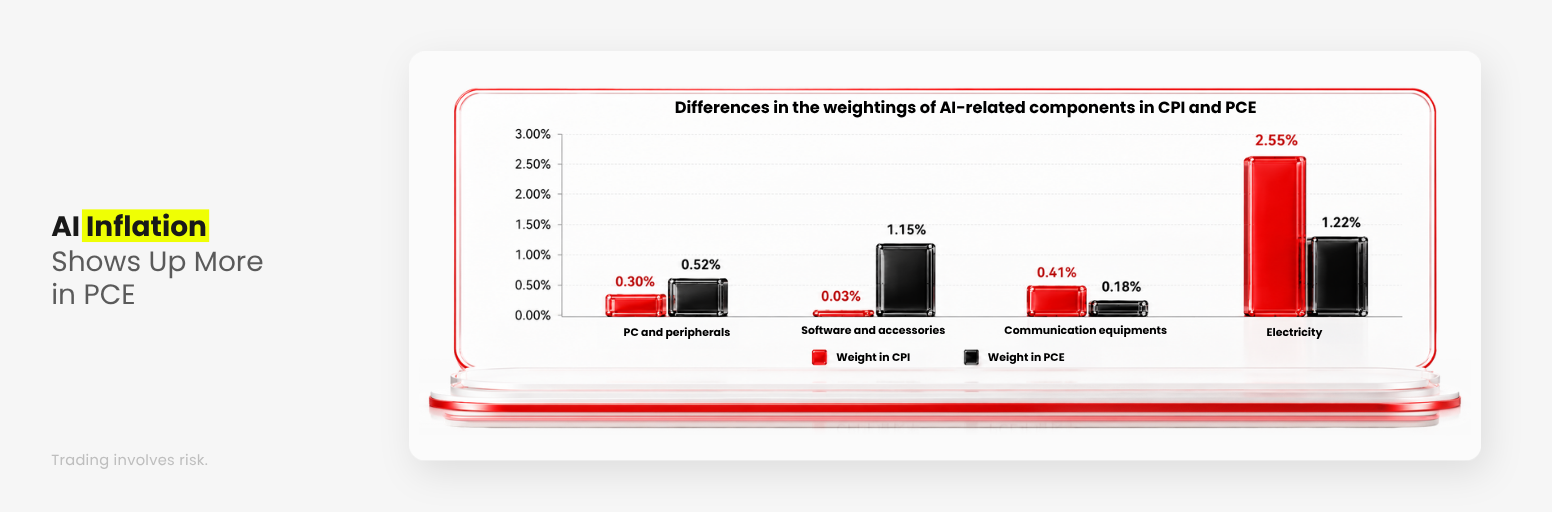
But overall, the direct impact of AI on CPI remains negligible. Since the Fed bases rate decisions on measurable indicators, AI inflation alone is unlikely to become a strong reason for an immediate hike.
Will Fading Rate-Hike Bets Lift Tech Stocks?
Tech stocks have started to rebound recently, especially semiconductor names.
Fading rate-hike expectations are clearly supportive for tech stocks. When the risk of tighter liquidity falls, long-duration growth assets usually benefit.
With GDP, nonfarm payrolls, and CPI all weakening, the market may now be seeing a policy bottom. The previous tech selloff also cleared out many weaker positions, giving the market room for a rebound in August.
But D Prime believes this rebound is likely temporary, not a full reversal.
The issue is valuation and profit potential.
Many leading tech names had already rallied sharply before the recent correction. After prices moved higher, the upside for some crowded trades became less attractive. As funds take profits from the rebound, capital may rotate toward subsectors with stronger earnings certainty for next year.
For now, the market still lacks a clear leading theme outside AI hardware.
That means tech stocks can rebound as rate-hike pressure fades, but the rally may remain selective.
Is Gold Entering a Bullish Uptrend?
Gold may have the stronger setup.
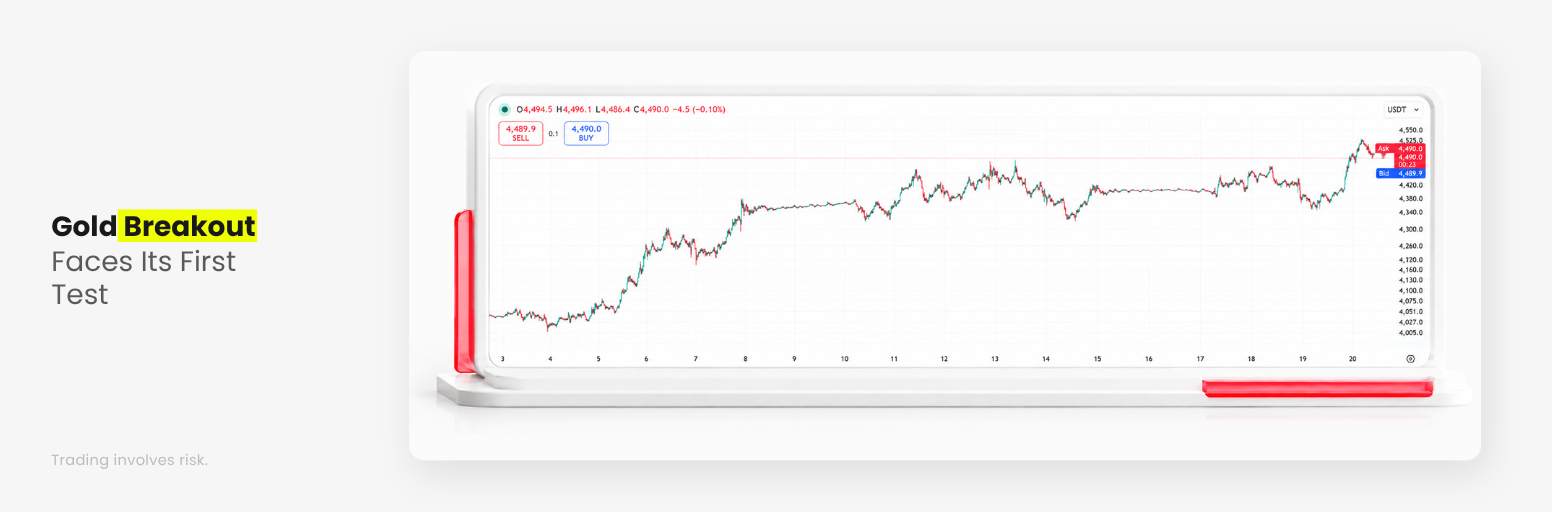
After months of rangebound trading, gold has started to regain momentum. At Monday’s open, gold broke through its previous high and began testing that level as support.
Some analysts believe gold has entered a confirmed uptrend and could rise toward USD 4,700 to USD 5,000 per ounce in September.
That forecast is aggressive, but the logic behind gold’s strength is becoming clearer.
Gold prices are mainly driven by two forces: US dollar interest rates and US dollar credibility.
On the interest-rate side, fading rate-hike expectations are pushing real US Treasury yields lower. Historical data suggests every 100-basis-point drop in TIPS corresponds to roughly a USD 1,600 per ounce rise in gold prices.
Based on that relationship, an 18 to 28 basis-point drop in TIPS could lift gold by around USD 294 to USD 441 per ounce. If this plays out around the September FOMC meeting, falling real yields alone could push gold toward roughly USD 4,635 to USD 4,782 per ounce.
That does not guarantee gold will reach those levels, but it explains why traders are watching the breakout.
Gold also benefits from renewed US dollar credibility concerns. Since July, AI trades have cooled, and questions around Fed independence have returned. Combined with continued central bank buying, this gives gold a stronger macro setup.
What Lower Rate-Hike Bets Mean for Gold and Tech
US July CPI cooled in line with expectations, but the bigger signal is the broader macro shift.
GDP is slowing. Payrolls have weakened. CPI and PCE are easing. Together, these data points make a Q3 Fed rate hike less likely.
That should support risk appetite in the short term, especially for tech stocks pressured by rate-hike fears.
But gold may have the stronger setup.
Tech stocks could rebound as the policy overhang lifts, but valuation pressure may cap the move. Gold has support from falling real yields, weaker dollar expectations, renewed dollar-credit concerns, and steady central bank demand.
The market remains volatile, and September FOMC expectations could still shift quickly.
But if rate-hike bets continue to fade, gold may have a stronger case than tech for the next major move.
By D Prime Analysis Team
Macro and market strategy research by D Prime’s in-house analysis team.
Risk Disclosure
Trading in Securities, Futures, contracts for difference (CFDs) and other financial products carries high risks due to the rapid and unpredictable fluctuation in the value and prices of these financial instruments. This unpredictability is due to the adverse and unpredictable market movements, geopolitical events, economic data releases, and other unforeseen circumstances. You may sustain substantial losses including losses exceeding your initial investment within a short period of time.
You are strongly advised to fully understand the nature and inherent risks of trading with the respective financial instrument before engaging in any transactions with D Prime. When you engage in transactions with us, you acknowledge that you are aware of and accept these risks.
Disclaimer
The information contained herein is provided for general informational and educational purposes only and does not constitute investment advice, financial advice, trading advice, a recommendation, or an offer or solicitation to buy or sell any financial instruments or engage in any trading strategy.
Trading in leveraged products such as contracts for difference (CFDs) involves a significant risk of loss and may not be suitable for all investors. Past performance is not indicative of future results. Any references to market trends, asset performance, price levels, or forward-looking statements reflect opinions or general market commentary as at the date of publication and are subject to change without notice.
This article does not take into account any individual investor’s objectives, financial situation, or risk tolerance. Readers should conduct their own independent research and seek professional advice before making any investment or trading decisions. D Prime and its affiliates make no representations or warranties about the accuracy or completeness or reliability of this information and disclaim any and all liability for any direct, indirect, incidental, consequential, or other losses or damages arising out of or in connection with the use of or reliance on any information contained herein. The above information should not be used or considered as the basis for any trading decisions or as an invitation to engage in any transaction. Do not rely on this report to replace your independent judgment.
“D Prime” is a brand name of D Prime Vanuatu Limited, a company incorporated and regulated by the Vanuatu Financial Services Commission (Company Number: 700238). The availability of products and services may vary depending on jurisdiction and applicable regulatory requirements.